
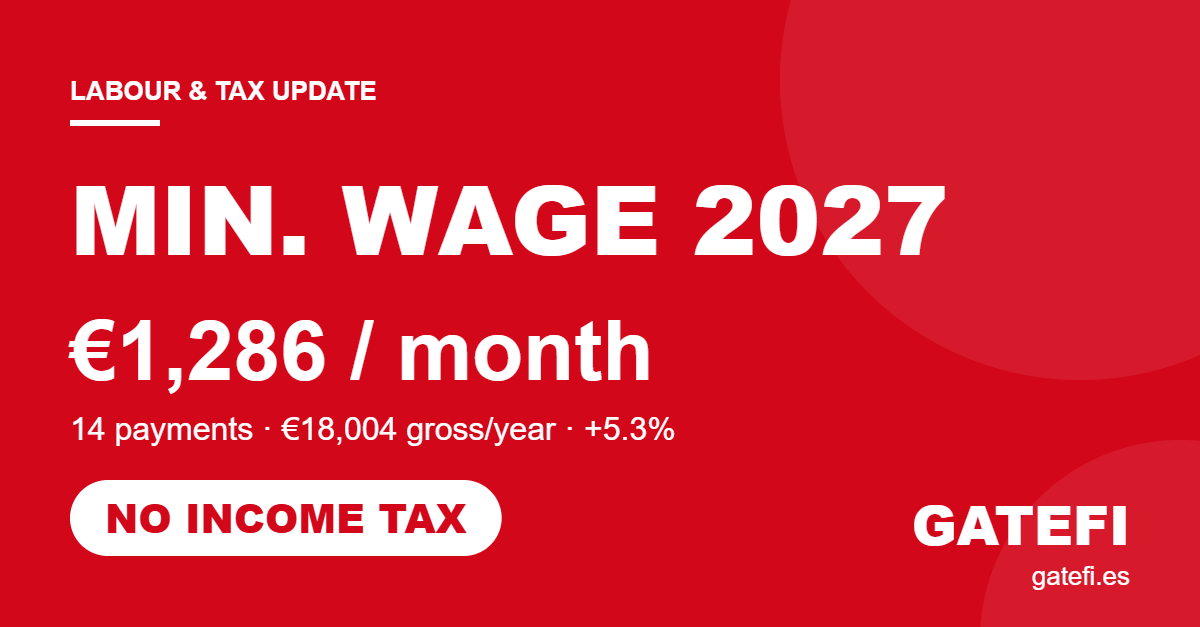
The minimum wage 2027 in Spain is now official: the Government has approved this week the increase of the Salario Mínimo Interprofesional (SMI) and, at the same time, has published a tax rule so that the increase does not mean paying more personal income tax (IRPF). Here is a summary of both announcements and what your company should review.
1. The minimum wage 2027 rises 5.3% from 1 January
The minimum wage 2027 (SMI) goes up to €1,286 gross per month in 14 payments, that is, €18,004 gross per year. That is €65 more per month than in 2026 (€1,221) and €910 more per year. If the salary is spread over 12 payments, the monthly minimum equals €1,500.33 gross.
The amount is set by Royal Decree 1013/2026, approved by the Council of Ministers on 17 November, and applies from 1 January 2027. For comparison, you can read Royal Decree 126/2026, which set this year’s minimum wage, and the news report on the approval of the increase (in Spanish).
2. The minimum wage 2027 increase is not taxed under IRPF
When the SMI rises, some of the employees who earn it could start paying IRPF or having tax withheld from their pay. To avoid this, Royal Decree-law 38/2026 of 17 November, published in the BOE (Spain’s Official State Gazette) no. 287 of 18 November 2026, amends the IRPF Act and the IRPF Regulations. It does so in two ways:
- The deduction for employment income is increased. For gross employment income of up to €18,004 per year, the deduction will be €1,033.58 and the tax due will be zero.
- Withholding on payslips is avoided. Article 85 of the IRPF Regulations is amended so that anyone earning the SMI does not have tax withheld each month. They will not need to file a tax return just to get withheld tax back.
The rule generally enters into force on 19 November 2026, but articles 5 and 6, the ones that affect IRPF, apply from 1 January 2027. The same royal decree-law also includes measures on the resources of the regional financing systems. Something similar happened in 2026, when Royal Decree-law 5/2026 adapted the deduction to that year’s minimum wage.
What about those who earn slightly more than the minimum wage 2027?
The measure also reaches the salaries just above the minimum, to avoid the so-called “jump error”, which happens when a small pay rise ends up increasing the tax. If employment income is between €18,004 and €23,171.89 per year, the deduction will be €1,033.58 minus 20% of the amount above €18,004. It had already been announced that the Tax Ministry would raise the deduction so that those on the minimum wage do not pay tax (in Spanish).
An example: with €20,000 gross, the difference is €1,996, 20% of that is €399.20 and the deduction is €634.38.
To apply it, you cannot have other income, excluding exempt income, above €6,500 per year.
What about the self-employed?
The deduction refers to employment income arising from an employment or statutory relationship. It is not designed for the income of a self-employed person’s business activity. If you work for yourself and have questions about your case, get in touch.
What should your company do about the minimum wage 2027?
- Review the contracts and payslips of employees with salaries close to the minimum before January.
- Update any salaries that fall below the new SMI, including collective agreement pay scales that fall below it.
- Check that the payroll software applies the new withholding procedure from 1 January 2027.
- Let employees know that no IRPF will be withheld from their pay if they earn the SMI.
At Gatefi we handle the labour, tax and accounting side of many companies and self-employed professionals. If you have any questions about how this affects you, get in touch and we will review it with you.









Leave A Comment